Clemente’s Corner: Get Ready for the Gavin McKenna Rookie Card Hype
Gavin McKenna, this year’s No. 1 overall pick in the 2026 NHL draft, has collectors are watching closely to see whether his rookie cards will become the next big thing in the hobby.
Inevitably, they will be.
The hype surrounding McKenna is easy to understand. Before ever playing an NHL game, he built an impressive resume. He dominated at the junior level, made the jump to Penn State and immediately became one of the most talked-about young hockey players.
Now he is headed to the Toronto Maple Leafs, one of the league’s biggest markets, and Upper Deck has signed him to an exclusive autograph trading-card deal. That combination is almost tailor-made for the modern hockey-card market.
But why are collectors willing to pay so much for NHL rookies in the first place? It’s a question I’ve asked myself every fall.
The Bedard Effect
Connor Bedard rookie – and pre-rookie – cards were hot sellers during his first season in the NHL. [Photo by Clemente Lisi]To fully understand the current rookie-card frenzy, look no further than Connor Bedard. He entered the NHL in 2023 as one of the most-hyped prospects in decades. He was selected first overall by the Chicago Blackhawks and arrived in the NHL carrying enormous expectations.
His rookie season only increased the hype. Bedard finished with 61 points in 68 games as an 18-year-old, and his Upper Deck Young Guns rookie card quickly became one of the most desirable modern hockey cards.
2023-24 Upper Deck #451 – Connor Bedard Young Guns
The excitement wasn’t limited to his standard rookie card. Collectors chased autographs, numbered parallels, short prints and other variations. Extremely rare versions attracted enormous prices.
Bedard demonstrated something important about today’s hobby: Collectors don’t necessarily have to wait for a player to do anything before putting serious money into his cards. They’re willing to bet on potential. That is where things get interesting for McKenna.
Social Media Hype
There has always been something special about a player’s rookie card. Those old enough to remember know that Eric Lindros was all the rage in the early 1990s.
We’ve come a long way since then. The hobby dramatically changed post-pandemic. Former collectors came back into the hobby and new ones emerged. In hockey, Young Guns cards have become the benchmark for rookies. For more than 30 years, collectors have chased the Young Guns cards of the NHL’s biggest stars.
The pattern is easy to see. When a player becomes a superstar, collectors want his rookie card. The problem is that everyone else wants it, too. While there is plenty of supply to meet the demand, that doesn’t stop prices from going up. Graded versions, of course, bring in a higher cost.
Accelerating the demand is something that collectors in the 1990s have: instant access via social media.
Collectors can see a player score a highlight-reel goal and immediately discuss it on social media. They can check recent auction results from their phones, buy a card online and have it shipped across the country. Social media has also created a constant stream of hype and FOMO.
The Speculation Game
There’s another reason rookie cards have become so expensive: speculation.
Collectors aren’t necessarily buying a rookie card based on what a player has accomplished. They’re buying it based on what they think he will accomplish.
That’s an important distinction. A $500 rookie card doesn’t necessarily mean the player has already generated $500 worth of accomplishments. It can mean buyers think that five years from now, the player could be an MVP contender or Stanley Cup champion.
That’s the sports-card version of investing in potential. And potential is dangerous. If the player becomes a superstar, those early prices can look like bargains.
When it was released, Alexis Lafreniere’s Young Guns rookie card was selling for up to $600. Today, it’s a $10 card.
If he struggles, gets injured or simply fails to live up to the enormous expectations placed on him, collectors can be left holding an expensive piece of cardboard that isn’t nearly as valuable as they hoped. Just ask all those collectors who purchased Alexis Lafrenière Young Guns cards at the height of COVID-19.
What About McKenna?
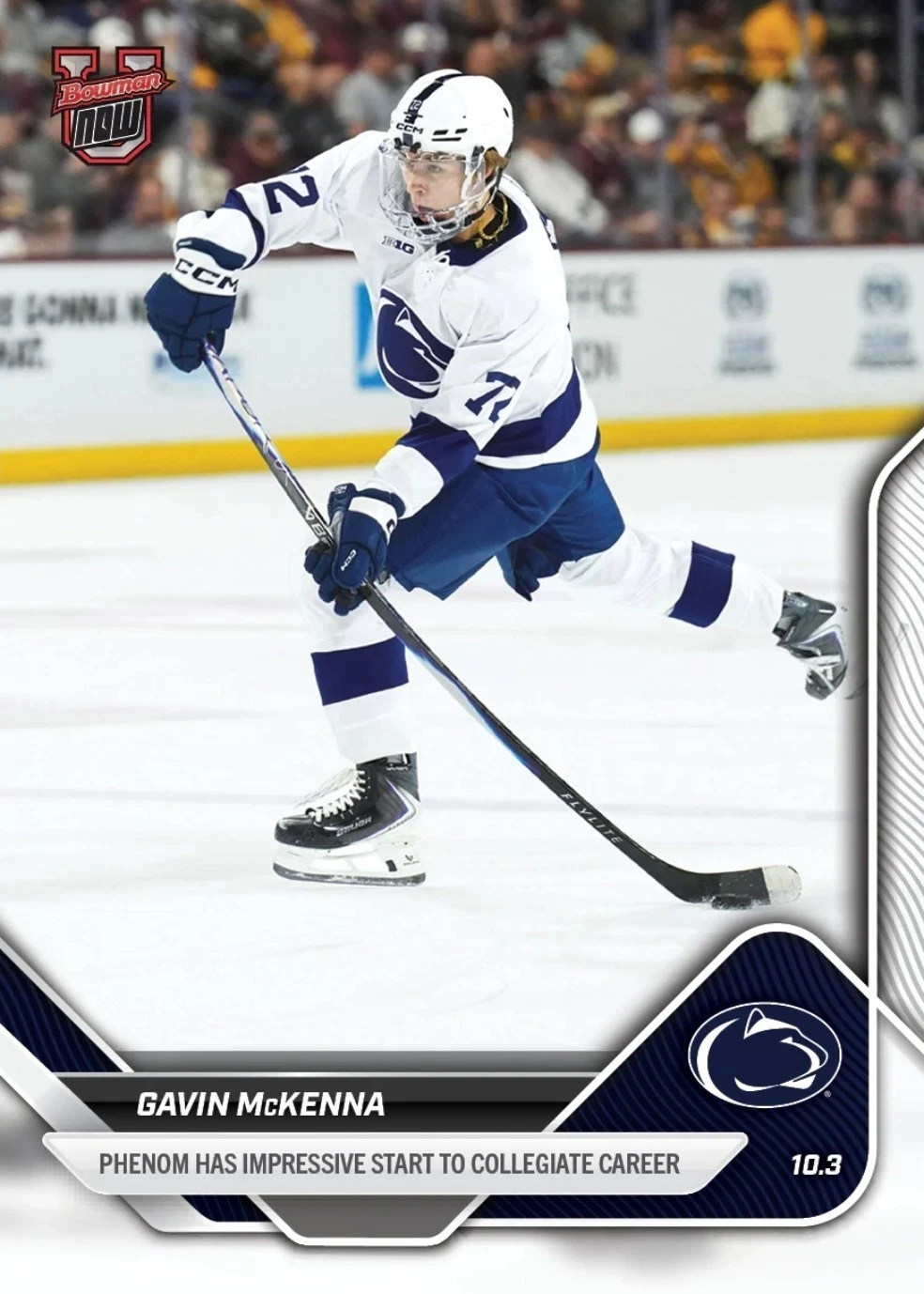
McKenna appeared on several Bowman U cards issued by Topps during the 2025-26 season. These cards pictured McKenna with Penn State.
McKenna has almost every ingredient collectors look for. He’s a first overall pick and coming into the league with enormous expectations. And now he’s joining the Maple Leafs, a franchise with one of the largest and most passionate fan bases in hockey.
His Upper Deck partnership means collectors already know there will be significant interest in his rookie cards. But here’s the important part: Nobody really knows how good McKenna will actually be in the NHL.
That’s what makes rookie cards so much fun to collect — and also so risky.
Clemente Lisi is a lifelong Rangers fan who first started collecting cards in 1986. He collects both vintage and modern with a focus on rookie cards. Follow him on Twitter @ClementeLisi.
View all posts by Clemente Lisi