Sal Barry is the editor and webmaster of Puck Junk. He is a freelance hockey writer, college professor and terrible hockey player. Follow him on Twitter @puckjunk
All-Star. Author. MVP. Enforcer. John Scott may be the only one who can claim to be all of the above. In his new autobiography, “A Guy Like Me: Fighting to Make the Cut,” Scott takes us through his journey on how he went from a fourth-line enforcer to All-Star MVP. Anyone who wanted a tell-all about last year’s drama surrounding Scott’s controversial inclusion in the NHL All-Star Game will get that here — and more.
Unlike most of the other hockey sets from 1990-91, Score did not bother to put checklist cards in their hockey cards sets that year. However, collectors who wanted a complete list of the available cards could mail away for a page-sized (8 1/2″ by 11″) checklist. It is actually quite attractive, printed in red and blue ink and neatly lists the cards in six columns on a single side of a page.
The “1990 NHL Hockey Player List,” as it is called at the top, lists all 440 cards, including the different “American-only” and “Canadian-only” variants, as well as the five special Eric Lindros cards that were available only in the boxed sets. A key that runs along the bottom of the page deciphers the different subset cards, such as Record Setters (RS), Trophy Winners (T) and ’90 Prospects (P).
The offer was advertised on packs of 1990-91 Score trading cards.
1990-91 Score Hockey pack (Photo credit: @LindyRuffsTie)
You had to mail in $1.00 and wait six weeks.
The back of the wrapper advertised the checklist offer. (Photo credit: @LindyRuffsTie)
The full text reads:
1990 SCORE NHL HOCKEY CHECKLIST To order your complete 440 player card checklist, send a check or money order for $1.00 (U.S.) made payable to Major League Marketing along with your name and address on a 3″x5″ card and mail to: 1990 SCORE NHL Hockey List, Major League Marketing, 25 Ford Road, Westport, CT 06680. Connecticut residents add 8% sales tax. Promotion good while supplies last. Allow six weeks for shipment.
If I recall correctly, the checklist was mailed in business-sized envelope. My checklist is folded in thirds horizontally, and would fit perfectly in a #10 envelope. (As a kid, I folded it a few more times so that it would fit in a box with cards.)
With companies putting their complete trading card checklists online, mailing away for a paper checklist today seems almost unthinkable; even more pointless than putting checklists in the packs of cards, like some companies still insist on doing.
But just imagine a world where you would write a letter to a card company, ask them for a paper checklist, and then they would mail one to you six weeks later. We used to live in that world.
Did you send away for one of these 1990-91 Score Checklists back in the day? Did it help you keep track of your set? Did you actually mark it up? Leave a comment below. ■
Special thanks to @LindyRuffsTie for providing the Score pack images.
Not only was 2016 a great year for hockey collectibles, but it was a great year for this website, too. Readership has steadily grown over the past nine years, and I have all of you to thank for that. While I am working on some new articles for 2017, I just wanted to share this list of “must reads” from the past year. These were Puck Junk’s top articles from 2016:
Happy New Year! With the holidays and other obligations requiring my focus over the past few weeks, I needed to take a little break from Puck Junk and turn my attention elsewhere. But now I am back on track and ready to start writing about hockey goodness once again in 2017.
Before we get on with the new, I thought it would be good to take a look back at the year that was 2016. Yes, a lot of cool people died — rest in peace, Princess Leia and Ziggy Stardust — and a mean Oompa Loompa was elected as U.S. President.
But 2016 wasn’t a bad year for hockey collectors. We saw the introduction of a new way to buy cards, a new type of hockey card altogether, and so much more. Here are the biggest hockey collectible stories of 2016. Continue reading “Top 10 Hockey Collectible Stories of 2016”
It was a frosty Chicago afternoon in late December of 1991. I was on break from school. The “Christmas money” was burning a hole in my wallet. It burned hot enough to make me brave the cold and venture out to the local mall. For those who grew up in Chicago, the mall I speak of was the Brickyard. Back in its heyday, the Brickyard Mall was Chicago’s premier indoor shopping center. It was torn down in 2002 and rebuilt as an outdoor monstrosity, but I digress.
The Osco Drug store at the Brickyard had one side of an entire aisle dedicated to just sports cards. But behind the camera counter is where they kept the good stuff; cards like Upper Deck or Stadium Club, and not the usual 50-cents-per-pack swill like Topps or Score. Behind the counter was a full, unopened box of hockey cards that I had never seen before: Pro Set Platinum Series One.
At a glance:
– 1991-92 Pro Set Platinum Hockey
– 300 cards
– 20 “Platinum Collectible” inserts
– Size: 2 1/2″ x 3 1/2″
– Download checklist
Man, was I excited! Even though I religiously read Beckett Hockey Magazine, this was the first I had heard of Pro Set issuing a high-end set of hockey trading cards. I don’t recall what they cost, but I think they were around $1 per pack. I eagerly purchased the entire box. I hurried home and opened every pack while sipping hot cocoa, and made two complete, 150-card sets; the good old days indeed.
The Los Angeles King gave a collectible holiday greeting card to their season ticket holders in December of 1992. How do we know that it is collectible? Because it has the Upper Deck logo and a serial number. In your face, Hallmark!
By the way, I should start serial-numbering all of the Christmas cards that I send out so that people save them for future collectibility and/or investment value. Of course, that would mean that I would have to actually send out Christmas cards in the first place.
Anyway, the front of the card shows a group of Kings celebrating a win at the old Great Western Forum. Robb Stauber (#35) looks eager to mess up fellow goalie Kelly Hrudey’s hair some more, as if that was possible. But the other side of the card is way better. It has a detailed illustration of Continue reading “1992 Los Angeles Kings Holiday Card”
In his new autobiography “Bleeding Blue: Giving My All for the Game,” Wendel Clark reflects on his first year of junior hockey with the Saskatoon Blades of the Western Hockey League. What impressed Clark so much was that he had his own hockey trading card and his own poster to sign for fans at autograph sessions. However, something about the poster wasn’t quite right, Continue reading “Wendel Clark Recalls His Saskatoon Blades Hockey Poster”
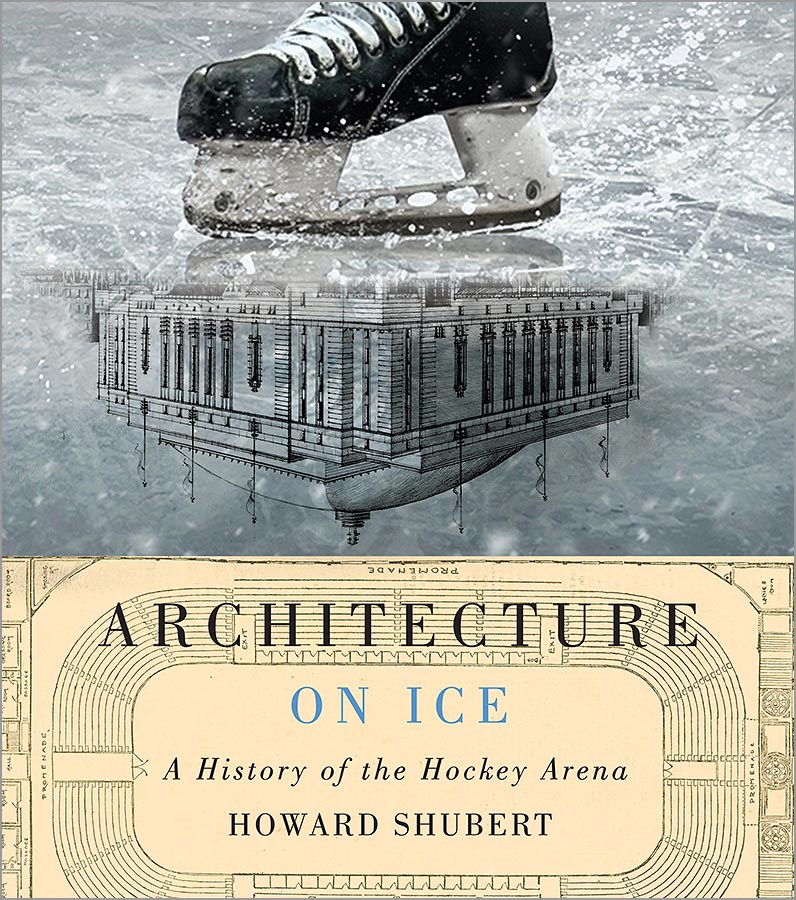
The hockey rink has come a long way, from its humble beginnings as a frozen pond encircled by snow banks, to “old barns” like Maple Leaf Gardens, to the mall-like sports entertainment complexes of today. How this happened over the past 150 years is explained in “Architecture on Ice: A History of the Hockey Arena.” Author Howard Schubert examines the cultural factors that contributed to the evolution of the hockey rink. This is no coffee table book; this is the history book you wished for in high school.
Emergency backup goalies are a celebrated story-of-the-day that happen usually once per season, when a seemingly Average Joe gets to be an NHL player for a game. Who could forget the Washington Capitals web producer who got to be the Caps’ emergency backup in 2008 and again in 2013? Or when Jim Schoenfeld’s son, Nathan, backed up the Arizona Coyotes for a game last season? Most recently, Philadelphia native Eric Semborski was an emergency backup for the Chicago Blackhawks when they played the Flyers in Philly on Saturday. But Semborski got something his predecessors didn’t: he got his own hockey card.
Two, in fact.
In the Topps Skate digital trading card app, Semborski was the subject of two hockey cards, released just four days after he suited up for the ‘Hawks.
Player not working? Listen to this podcast on SoundCloud.
In the latest Puck Junk Podcast, Sal and Tim (@TheRealDFG) talk about:
Playing fantasy hockey on Topps Skate
The Vegas Golden Knights’ name, color, jersey and logo
Gerard Gallant being fired by the Florida Panthers
Lighthouse Hockey’s campaign to make N.Y. Islanders’ third-string goalie J.F. Berube an NHL All-Star Game captain
Podcast #20 weighs in at 55:31, so have a seat before you click play.
Theme music by Jim “Not the Goalie” Howard.
So, what do you think about the new Vegas team, the Panthers firing Gallant or the push to get J.F. Berube into the 2017 All-Star Game? Leave a comment below. ■